The short answer
The 153rd Kentucky Derby runs Saturday, May 1, 2027, Oaks on Friday, April 30. Louisville’s hotels gate the weekend with two- and three-night prepaid minimums. Jeffersonville, Clarksville, and New Albany, minutes across the Ohio River, mostly don’t. Base in Indiana, and pick your town by bridge: two crossings are free, and I-65 is not.
How Louisville locks the weekend
We keep getting search traffic from people asking, in various spellings, for Derby lodging on the Indiana side. Fair question. Nobody on page one answers it with anything you could act on, so here’s the whole thing.
First, understand what you’re routing around. The Derby is the easiest event in sports for a hotel revenue manager, the person who sets rates night by night. The date has been the first Saturday in May since forever, demand shows up every single year, and Churchill Downs started selling two-day 2027 ticket packages in June 2026. Eleven months out, the managers already watch bookings arrive. So they don’t just raise prices. They fence the weekend.
The fences, specifically: minimum length-of-stay controls and prepaid, non-refundable terms. Local news coverage across multiple Derbys confirms two- and three-night minimums are the market standard, and the flagship properties push harder. Ahead of Derby 150 in 2024, the Marriott Louisville Downtown required a three-night, non-refundable, paid-in-advance booking, told WYMT that Derby weekend alone brings 10% of its annual revenue, and sold out all 600-plus rooms by March. The same week, a reporter’s spot check found a two-night stay at one downtown boutique property listed above $7,000, and nothing downtown under $1,000 for two nights.
Hold that against the baseline. Hotel-price tracking by Engine puts Louisville’s ordinary average around $132 a night. This is not a supply problem like Lexington’s Breeders’ Cup squeeze, where a small city literally lacks the beds. Louisville has the beds. What it does is weld terms onto them: you’ll buy more nights than you may want, in advance, with no exit. Our refundable-rate playbook is built on holding free options. Derby-week downtown Louisville is the market that deletes the option from the rate card.
The official route doesn’t restore it. Derby Experiences, Churchill Downs’ official experience package provider, already sells 2027 packages bundling tickets, hospitality, and hotel nights. Those bundles have their own logic and their own sales-final reality; we took packages apart in the official-packages piece, and everything there applies here.
Across the river, the machine mostly isn’t running. The Indiana towns price off their own local calendars. Rates rise for Derby weekend, sure, but chain properties there generally still sell normal terms: one night if you want it, refundable if you pick the flexible rate. One honest data point cuts both ways and is worth knowing: WHAS11 has reported Derby weekends where Jeffersonville hospitality businesses were surprised by low bookings. The Indiana side does not reliably sell out. That’s exactly why it works for you.
The ladder, town by town
Three river towns face Louisville, and they are not interchangeable.
Jeffersonville is the scene pick. Its riverfront restaurant district sits directly across from downtown Louisville, and the Big Four Bridge, a converted 1895 railroad span that’s now pedestrian-only, lands you in Waterfront Park on foot. More than 1.5 million people cross it a year. On Oaks and Derby nights that walk is the commute nobody surges: over the river, skyline in front of you, into the Whiskey Row crowd, back whenever you’re done. The track is a separate trip (roughly four miles south of downtown), so budget a shuttle or rideshare for race days themselves.
Clarksville is the middle rung, tucked between the other two, with interstate-exit chain stock and not much else in this context. Nothing wrong with it. You’d pick it on price, not on anything the town gives you.
New Albany is the driver’s pick, and the reason is the next section. It faces west Louisville, a few miles further from the downtown party than Jeffersonville, with a small downtown of its own. If your Derby plan is “drive to the track area both mornings, park on a local’s lawn, drive home both nights,” New Albany’s geometry beats everyone’s.
One more river town shows up in searches: Utica, up at the east-end Lewis and Clark Bridge, across from Prospect. Skip it for Derby purposes. It’s the wrong corner of the metro for Churchill Downs, and its bridge is one of the tolled ones.
The bridge math nobody checks
Here’s the part a booking site will never tell you, because it lives on a tolling authority’s rate page instead of a hotel’s.
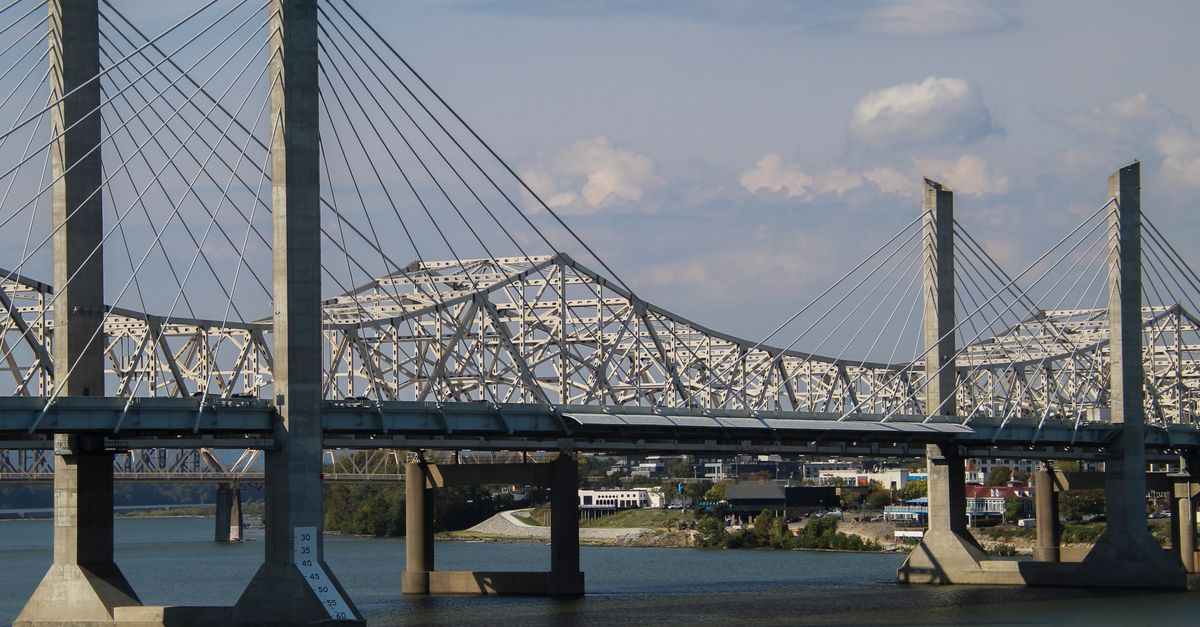
Five road crossings link the two banks, and they split cleanly. Tolled, under the RiverLink system: the twin I-65 spans downtown, the Kennedy Bridge (southbound into Kentucky) and the Abraham Lincoln Bridge (northbound into Indiana), plus the Lewis and Clark Bridge on SR 265 at the east end. Free: the Sherman Minton Bridge carrying I-64 between New Albany and west Louisville, and the Clark Memorial Bridge, the Second Street Bridge, carrying US 31 from Jeffersonville straight onto downtown streets. The Big Four is free too, but you’ll be on foot.
There are no toll booths. Cameras read every car. As of the rates that took effect July 1, 2026, a passenger-car crossing costs $2.79 with a transponder and prepaid account, $4.18 on a prepaid pay-by-plate account, and $5.57 with no account, invoiced by mail to whoever the plate is registered to. An E-ZPass from any state works here at the transponder rate. RiverLink adjusts rates each July 1, which means these exact numbers hold through Derby Day 2027; the next bump lands two months after the race.
Run the worked example. Three nights in Indiana, Oaks Friday and Derby Saturday, driving I-65 both ways daily: six crossings. Unregistered, that’s $33.42, arriving weeks later as a paper invoice. With an E-ZPass, $16.74. Via a free bridge, zero.
Be straight about the size of that number: thirty-three dollars will not rescue a Derby budget, and if I-65 is genuinely your fastest route, pay it and drive. The toll matters for three other reasons. It’s entirely avoidable with a town choice you were making anyway. In a rental car, the pay-by-mail invoice routes through the rental company’s plate instead of yours, so bring your own E-ZPass from home and the charge stays clean and small. And it quietly settles the Jeffersonville-versus-New-Albany question for drivers: New Albany’s track route, I-64 over the free Sherman Minton to the I-264 loop, never passes a gantry, while Jeffersonville’s free option, the Clark Memorial, dumps you onto downtown surface streets on the two most congested days of Louisville’s year. Jeffersonville earns its keep on foot. New Albany earns it behind the wheel.
Rentals, on both banks
The Derby house-rental economy is real and old; Louisville families have rented out homes for Derby week for generations, and WDRB reported short-term rentals averaging about $600 a night with nearly 2,000 bookings for a recent Derby weekend. Rentals are the right call for groups of four-plus splitting a whole house, and the Indiana river towns have their own supply at gentler prices.
Read the terms before you fall in love, though. Derby-week rentals commonly carry three-night minimums of their own, plus deposits and cancellation policies far stiffer than a flexible hotel rate. A rental fixes the per-person math. It does not fix the flexibility problem, and for a trip you’re booking seven-plus months out, flexibility is the asset. Whatever you hold, calendar the cancellation cutoff the day you book; the cutoff guide covers the mechanics and the time-zone trap.
The play, from September 2026
Book a refundable room in Jeffersonville or New Albany now. Rates on the Indiana side haven’t done anything dramatic yet, the flexible rate costs you nothing to hold, and you’ve capped your downside for a race eight months out. If you’d rather chase the full downtown weekend, price it with open eyes: three prepaid nights at Derby multiples is the market’s honest asking price for Whiskey Row on Derby Eve, and for some trips it’s worth it. Re-shop your Indiana booking over the winter and trade up if something better appears.
Then sort the bridge before the trip. Throw an E-ZPass in the glovebox or just learn where the Sherman Minton is. The full Louisville side of this, neighborhoods, shuttles, the bag policy, the infield question, lives in our complete Kentucky Derby guide.
Post time on May 1 is around 6:57 p.m. The bars on both banks stay open later than that.