The short answer
The 2026 Bank of America Chicago Marathon is over. Amos Kipruto won in 2:01:09 and Hawi Feysa repeated in 2:13:33 on a warm, yellow-flag morning, and Catherine Debrunner broke the women’s wheelchair world record. The next decision is 2027: applications for the October 10 race close at 2 p.m. Central on Thursday, October 29, 2026.
How the 48th running went
Kipruto, who finished third here in 2024 and second in 2025, finally got the win in 2:01:09. That is a personal best, 34 seconds off Kelvin Kiptum’s 2:00:35 course record from 2023, and the same number Eliud Kipchoge ran for the world record in Berlin in 2022. Tadese Takele was second in 2:02:56.
Feysa defended her title in 2:13:33, also a personal best, with Sharon Lokedi second in 2:14:07 and Brigid Kosgei third in 2:14:55. Clayton Young was the top American man in 2:05:23, which the race’s post-event release called the second-fastest ever by an American man. Emma Grace Hurley finished seventh in 2:20:47 on her debut and broke the American women’s debut record doing it.
The wheelchair races produced the headlines. Marcel Hug won in 1:21:34, taking a minute and three seconds off his own 2023 course record, his fifth straight Chicago title and seventh overall. Debrunner won the women’s race in 1:33:16 and cut a full minute off the world record she set in Berlin in 2023, the first wheelchair world record ever set in Chicago. She was almost nine minutes clear of Tatyana McFadden.
And it was hot. Organizers put the race on a yellow flag, the second of four levels in the event alert system, before the start. Temperatures sat near 60 at 7 a.m. and climbed into the mid-70s while most of the field was still running, well above the mid-60s average high for October 11 in Chicago. Medical staff flagged miles 15 to 19 as the exposed stretch and added sponge and misting stations. A yellow day is not a disaster, it is a recommendation to stop chasing a PR, and plenty of people in the back half took it.
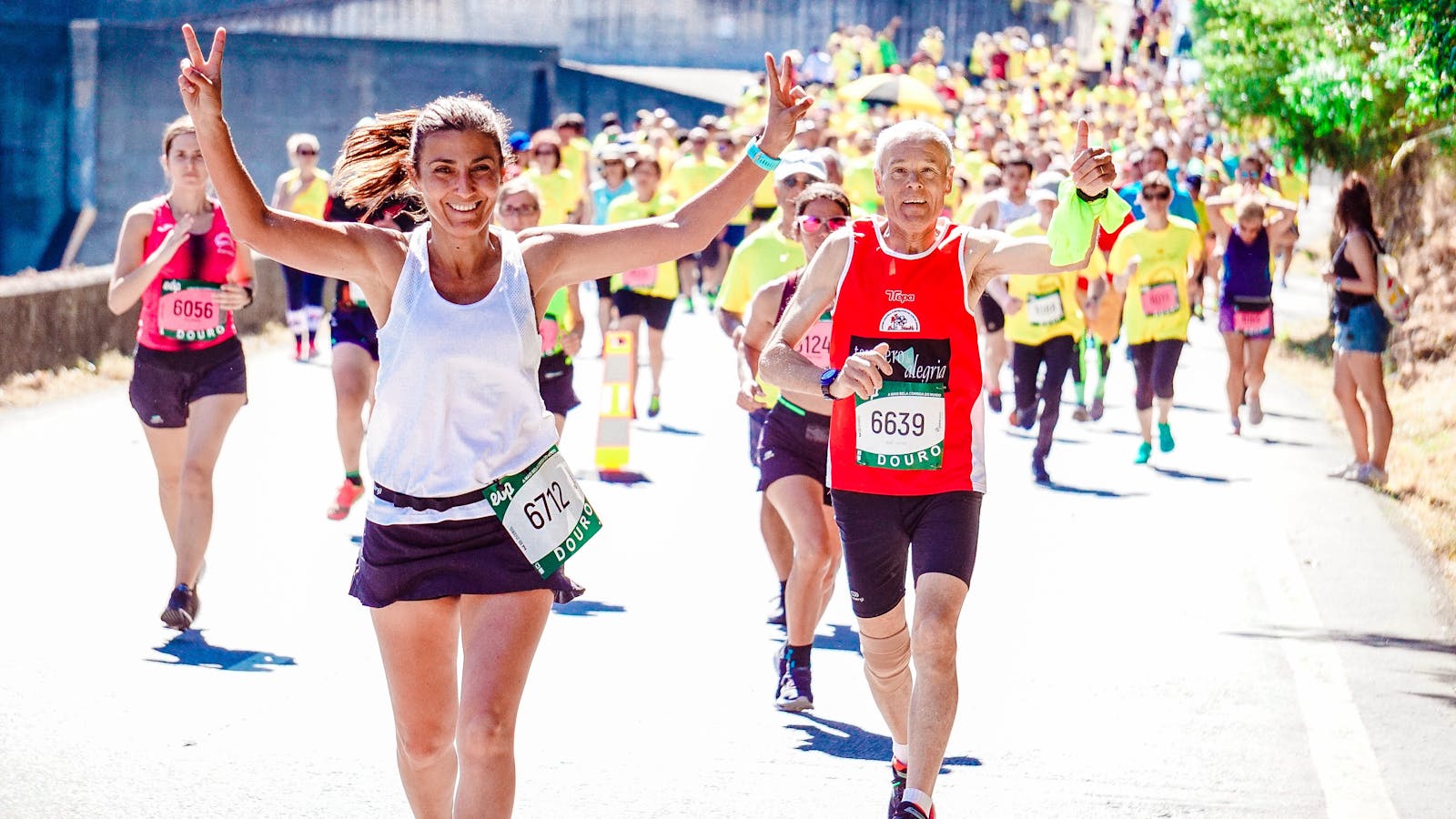
More than 54,000 participants ran the 29-neighborhood course, from all 50 states and more than 100 countries, in front of over a million spectators, per the race’s post-event release.
What the room market actually did
This page was a booking guide for that weekend. Here is the part worth keeping.
More than 55,000 runners registered for 2026, out of a record 200,000-plus applications, and the official release counted more than 54,000 on the course. Registration always exceeds starters, which is the injured-and-under-trained attrition that quietly returns rooms to the market in the final fortnight. The people who got in were told on Thursday, December 11, 2025. Ten months of lead time, on a field where more than 75% travel from outside Illinois, is the entire explanation for why a September shopper in this market finds leftovers.
The money is not small. Jones & Associates Economics, in the study Bank of America commissioned on the 2025 race, put the economic impact at a record $756 million, up 7.5% in a year, supporting 5,186 full-time-equivalent jobs. The equivalent 2026 number should land around March 2027; the 2025 one was published in March 2026.
The thing a hotel search never showed you was the stacking. APTA’s TRANSform Conference and EXPO, the transit industry’s biggest annual show, ran October 4 to 7 at McCormick Place. It closed on the 7th. The marathon expo opened in the same building on the 8th. Two blocks of compression nights, back to back, on the same downtown room inventory, with no soft night in between. Revenue managers, the people who set nightly rates, had no reason to reopen a discounted tier, so the Loop rate that people had been watching since late September never blinked. If you were refreshing one property and wondering what was wrong with it, nothing was.
The cutoff ladder, pointed at 2027
A cutoff grid is only worth anything if the dates are still ahead of you, so this one is built for Sunday, October 10, 2027. Find your check-in night, find the policy on your rate, and that is the calendar date your money stops being refundable.
| Your check-in night | 7-day cutoff | 72-hour | 48-hour | 24-hour |
|---|---|---|---|---|
| Thursday, Oct 7, 2027 | Sept 30 | Oct 4 | Oct 5 | Oct 6 |
| Friday, Oct 8, 2027 | Oct 1 | Oct 5 | Oct 6 | Oct 7 |
| Saturday, Oct 9, 2027 | Oct 2 | Oct 6 | Oct 7 | Oct 8 |
| Sunday, Oct 10, 2027 | Oct 3 | Oct 7 | Oct 8 | Oct 9 |
Event-dated rates often carry longer terms than the four above. A 14-day cutoff on that weekend falls between September 23 and 26, a 30-day between September 7 and 10. Those are the ones that surprise people, because the badge on the search result says “free cancellation” and the confirmation says otherwise.
What the 2026 version of this grid did is worth one paragraph, because the shape repeats every year. The pile-up was Thursday, October 8: three separate cutoffs landed on it, the 24-hour on a Friday room, the 48-hour on a Saturday room, and the 72-hour on Sunday night. Then October 9 took the 24-hour on Saturday and the 48-hour on Sunday, and October 10 took the last free cancellation in the entire weekend. Four days, every exit closed. Cutoffs are also clock times the property picked, usually in the afternoon, so they are business-hours decisions rather than midnight ones. The cutoff fine print is where refunds go to die, and that page carries a calculator that does this arithmetic for your own dates. The broader logic lives in the refundable rate playbook, and if you have flexible dates, rates fall off a cliff once the crowd leaves.
Where to sleep, and this part doesn’t change
Chicago’s quiet advantage, and the thing that makes it completely different from New York, is that there is no race-morning transport problem. No ferry, no bus assignment, no 5 a.m. staging odyssey. The start is a city park ringed by hotels. Your race-morning commute is a walk, and your hotel choice decides how long it is.
In 2026 the clock went like this, and the structure is typical: Grant Park, gear check and corrals opened to runners at 5:30 a.m., Wave 1 corrals closed at 7:20 as the men’s wheelchair field went off, pros at 7:30, Wave 1 at 7:35, Wave 2 at 8:00, Wave 3 at 8:35. Security lines eat time. Gear check eats more. The porta-potty line eats whatever is left. A Wave 1 runner sleeping across the street leaves the lobby at 6:15 and strolls. The same runner sleeping two miles north is doing math in the dark.
Michigan Avenue and the Loop are the bullseye. The row of hotels facing Grant Park has been marathon headquarters territory for decades, and everything in the Loop proper sits inside a 10-to-15-minute walk of the gates. This zone books first and prices hardest, and it is worth it, because you also limp back to it in 20 minutes after you finish.
The South Loop is the sneaky-smart pick. You are closest to the Roosevelt Road end of the park, where the course’s one hill, a 25-foot bump locals call Mount Roosevelt and cruelly placed at mile 26, rolls into the Columbus Drive finish. You are also two stops from McCormick Place for the expo, and rates here typically run under the Michigan Avenue towers.
River North and Streeterville hold the deepest hotel inventory in the city plus the restaurant reservations you actually want for a Friday night. The tax is a mile-plus walk south on race morning, fine at 6 a.m., less fine at 5:45 with a Wave 1 corral deadline. Good for Wave 2 and 3 runners who would trade a longer walk for a better weekend.
McCormick Place is the convention-hotel pocket about two miles south of the Loop, next door to the expo hall. Quiet, practical, zero charm, and on a compressed weekend it is often where rooms survive longest. A 10-minute train ride covers the gap north.
Wherever you land, book the Sunday night too and sort a late checkout. The finish-line shuffle back to a checked-out lobby with a suitcase is a rookie mistake this race punishes gently and New York punishes hard.
The transport rules that repeat every year
Four things about race weekend in Chicago hold whatever the date is, and they are the reason a walkable hotel is worth paying for.
Grant Park closes before you get there. The inner drives go days ahead of the race, not on race morning. In 2026 the streets around the park were shut from Thursday through Monday afternoon: Jackson Drive from Michigan to Columbus through 8 p.m. Sunday, Balbo and Columbus from Ida B. Wells to Roosevelt through 3 p.m. Monday. So the park you cross at 5:45 on race morning is not the park on the map, and the walk you rehearse on Saturday is the one that counts.
Rideshare is fenced out of the start area. The race’s own instruction is that runners using rideshare get dropped off west of Michigan Avenue and south of Ida B. Wells Drive. Add traffic to that and you understand why a lobby across the street beats a cheaper room two miles out on the one morning of the year it matters.
If you drive in, park it and leave it. Posted no-parking zones along the course are strictly enforced and cars get towed. Michigan Avenue itself was closed from Madison to Roosevelt from 4 a.m. to 4 p.m. on race Sunday in 2026, and course streets reopen behind the last runners, which is mid-afternoon on the final stretches. The race also publishes a Millennium Garages promo code most years. For 2026 it was MARATHON26, 10% off daily and multi-day parking in the four underground garages beneath Grant, Millennium and Maggie Daley Parks, valid October 5 through 14, and the race told people to buy online in advance because walk-up race-day rates are higher and availability is not guaranteed.
There is a free bike valet. World Bicycle Relief runs one at the southeast corner of Michigan and Van Buren, bikes in from 4 a.m. and out by 4 p.m., with a Divvy-only valet at Michigan and Jackson. If you are a spectator staying in Lakeview or Logan Square, that is a real way into the park that does not involve a 7 a.m. Red Line platform.
Spectators: the course is a loop and the L is the whole plan
Two access rules shape a spectator’s day in Chicago, and they are the same every year. You cannot get near the start or finish lines without a bib, and general spectator access to Grant Park opens with the 27th Mile Post-Race Party at Butler Field, Columbus and Jackson, which in 2026 ran 9:30 a.m. to 4 p.m. with beer included. Spectators go through security at Gate 1 (Jackson and Michigan) or Gate 4 (Ida B. Wells and Michigan). So do not build the morning around the finish line.
Build it around the course instead. The chase that works: catch your runner in the miles 6-to-10 stretch through Lincoln Park, Lakeview and Boystown, which is the loudest sustained crowd on the route, then train back south and take the Pink Line to 18th Street to be standing in Pilsen for mile 19.25. Pilsen on marathon morning, mariachi bands and families three deep, is the best spectating in Chicago sports, and runners will tell you it arrives exactly when they need it. Cermak-Chinatown on the Red Line then drops you at mile 21.5 by the Chinatown Gate. Ride north and meet your exhausted person at the party. Three course sightings plus the reunion, all on one transit card.
If you are only spectating, sleep where the watching is. Lakeview puts you on the course at breakfast, Wrigleyville is next door, and the Red and Brown Lines handle the rest of the day.
The expo rule that writes your flights
Your bib exists only at the Abbott Health & Fitness Expo at McCormick Place, and you collect your own packet with a photo ID plus the Packet Pick-up email the race sends out. No proxy pickup. No race-day pickup, ever. The 2026 windows were Thursday, October 8 from 10 a.m. to 6 p.m. and Friday and Saturday from 9 to 6, in the North Building, Level 3, Hall B1 at 2301 S. Martin Luther King Drive, with a hard wall at 6 p.m. Saturday. Miss it and you watch from the sidewalk.
So a Saturday arrival leaves you one nine-hour window and no slack, and the cheapest itinerary mistake in this market is a delayed Saturday-morning flight. That rule is also why the hotel squeeze here runs Thursday through Sunday rather than one night.
The calendar quirk nobody prices in
Because the race always falls on the second Sunday of October, the Monday after is always the Columbus Day federal holiday, observed as Indigenous Peoples’ Day in a number of states. For 2027 that is Monday, October 11. Banks closed, federal offices closed, a chunk of the country off work, and most of a 55,000-runner field still books a Sunday-night departure out of habit. Take the Monday instead. Flight loads on a holiday Monday afternoon are kinder than Sunday night’s, and Sunday night in Chicago after finishing a marathon is the whole reason the post-race dinner exists.
The rest of the 2026 weekend’s sports calendar cooperated. The Bears were at Green Bay at noon Central on race Sunday and lost 31-7 at Lambeau. So there was no Soldier Field crowd competing for beds, just a city watching Bears-Packers from barstools while runners were still on the course.
Baseball split the city. San Diego swept the Cubs, 8-0 on September 29 and 4-1 the next night, so Wrigley’s season is finished and the North Side gets no October baseball. The White Sox went the other way, and then ran out of road. They swept Houston, 6-3 and 7-3, won both Division Series games in Cleveland, 3-0 on Saturday and 4-3 on Monday, and then lost both at home: 9-3 on Wednesday, October 7 and 9-5 on Thursday, October 8. That tied the series 2-2, and Cleveland won Game 5 at home 2-0 on Saturday, October 10, so the South Side season ended 344 miles up I-90 and Chicago has no October baseball left.
That mattered to a runner for one reason, and the reason is the Green Line. The only overlap marathon weekend could have produced was the expo against a Rate Field playoff crowd, because Hall B1 and the ballpark sit one stop apart on the Green Line, Cermak-McCormick Place and 35th-Bronzeville-IIT, with Sox-35th a stop over on the Red Line. That overlap landed on Thursday, October 8, the expo’s opening day, against a 7 p.m. Central first pitch. The two expo days that mattered to most of the field, Friday, October 9 and Saturday, October 10, both 9 a.m. to 6 p.m., had no ballgame on the South Side at all.
That also closed the NLCS question this page had been hedging since August, and it closed it the helpful way. The National League was Milwaukee against Los Angeles, and the Brewers swept it: Games 1 and 2 at American Family Field on Sunday, October 11 and Monday the 12th, then Games 3 and 4 at Dodger Stadium on the 14th and 15th, 6-2 and 6-4. So the nearest postseason baseball to Grant Park on race day was 90 miles north up I-94, which is the right distance from a hotel-market point of view: close enough that some Chicago-area Brewers fans drove up on Sunday evening, nowhere near close enough to bid against you for a downtown room. The 7 p.m. Central Game 1 was also the right clock for a finisher who wanted to watch it from a chair. The same geography held for the World Series: Game 1 was Friday, October 23 at American Family Field, Brewers 3, Rays 2, a 7 p.m. Central start, and the Series stays in Milwaukee rather than Chicago.
The American League settled the rest of it. Tampa Bay swept the Yankees and held home field over Cleveland, so the ALCS opened in St. Petersburg on Monday the 12th and Tuesday the 13th, moved to Progressive Field for Games 3 through 5, and ended back at Tropicana Field on Monday, October 19, Rays 7, Guardians 3, series 4-2. None of it was in Chicago. Marathon weekend, Friday the 9th through Monday the 12th, had no home game at either Chicago ballpark. The competition for a room was other runners. The convention and playoff pressure sat earlier in the week.
Getting into the 2027 race
The application window opened at 8 a.m. Central on Thursday, October 8, 2026 and closes at 2 p.m. Central on Thursday, October 29, 2026. It is a free application and the card gets charged only if you are drawn. Results go out by email on Tuesday, December 8, 2026, and the payment deadline is 11:59 p.m. Central on Tuesday, December 15. Entry is $250 for U.S. residents, $260 if you live elsewhere.
The ways around the drawing, which is worth taking seriously given 200,000-plus applications for roughly 55,000 spots:
- Time qualifier. A certified marathon run between January 1, 2025 and October 29, 2026 at a standard for your age and gender, ranging from 2:50:00 for men 16 to 34 to 5:20:00 for women 80-plus. Qualifiers pay by Tuesday, November 10, 2026.
- Legacy. Five Chicago finishes in the past decade.
- Charity. The 2027 program’s published minimum is $2,500, up from $2,200 for 2026, with a $325 entry fee for U.S. residents. Charity spots go first-come until each charity fills or Friday, September 10, 2027, whichever comes first.
- High Performance Program. 300 spots, under 2:25:00 for men and 2:45:00 for women, expanded for 2027.
- Distance Series. Finish the Shamrock Shuffle 8K on Sunday, March 21, 2027, the Chicago 13.1 on Sunday, June 6, 2027, and the 2027 marathon, and you get guaranteed entry into the 50th running in 2028. Shamrock Shuffle entry is $56 now that the $51 early rate ended on October 20, 2026, and the race site says it steps up again toward $72 as March nears; the 13.1 is $120. If a 50th-anniversary bib is the actual goal, this is the cheapest and most certain route to it, and the first leg costs about the price of a dinner.
One more thing about 2027: USATF has put its national marathon championships inside the race, with 20 American men and 20 American women racing for titles on October 10 and a purse near $110,000 across the top 10 of each. That is 40 extra athletes, so the championship itself does nothing to the hotel market. What it buys is a press week and the crowd that follows an Olympic Trials qualifier, which is the kind of demand that shows up in pickup pace in the spring rather than in race-week rates.
The booking move, then. Drawing results land Tuesday, December 8, 2026, and that is the day to hold a room, not the day to start reading about it. Check the official housing block first: the race’s participant-information page names Maritz as its housing partner, with room blocks at downtown hotels, a housing desk at 864.208.2935 and chi@maritz.com, and the Hilton Chicago on Michigan Avenue, 1,544 rooms facing Grant Park, as the official headquarters hotel. Maritz’s own line is that room availability changes frequently and to check back, which is the tell that a human is watching cancellations come back into that block. The phone gets you to that person faster than refreshing a search does. If the block is dry, work outward in this order: River North and Streeterville, then the McCormick Place pocket, then the Red, Brown and Blue Line neighborhoods. Hold it refundable, re-shop it in the spring, and walk away free if the build falls apart.
Rentals, honestly
Chicago is the rare marathon major where the vacation-rental answer is a real yes. Unlike New York, where whole-apartment short stays are effectively banned, Chicago has a working short-term-rental market, and a South Loop or West Loop condo is a legitimately good base for a family cheering squad or a four-runner crew who want a kitchen at 4:45 a.m. instead of a hotel breakfast that opens at 6:30.
The trades are the usual ones. Hosts flip to multi-night minimums for race weekend and cleaning fees hit short stays hardest, so compare all-in totals rather than nightly rates.
The cancellation policy is the real decider, and this is where most people stop reading too early. Vrbo lets each owner pick from seven tiers, and the spread between them is enormous. Day-before refunds 100% up to 24 hours out. Lenient does it to five days. Relaxed gives you a full refund at 14 days and half between 7 and 14. Moderate moves that wall to 30 days, Firm to 60, Strict refunds nothing inside 60 days, and No refund means exactly that. A high-demand race weekend is where owners sit on Firm or Strict, which is why “I’ll book the rental and figure out the bib later” goes wrong. Airbnb’s Flexible policy refunds in full until 24 hours before check-in, and as of October 2025 all four of its standard tiers carry a 24-hour grace period after booking. Airbnb pays us nothing for pointing that out. If the group is firm, book the rental when the calendars open about a year out and read the tier before you click. If anyone is still saying “probably,” hold the refundable hotel and decide in the spring.
New York is three weeks after Chicago
The New York City Marathon is Sunday, November 1, 2026, the 50th running of the five-borough course, and it is the opposite kind of problem. Your hotel does not get you to the start line in New York. A ferry or a bus does, the start is on Staten Island with a first wave at 8 a.m., and the booking logic changes accordingly. That page covers it.
Results, records, 2027 dates and fees here were verified on Sunday, October 11, 2026 against the race’s post-event release, chicagomarathon.com’s own future-dates, application, spectator and transportation pages, the Bank of America newsroom, the Chicago Sun-Times, CBS Chicago and Marathon Handbook. The expo, closure, parking and party details describe the 2026 arrangements and get re-checked when the race posts 2027’s. Hotel availability moves daily, so treat specific rooms as live inventory.